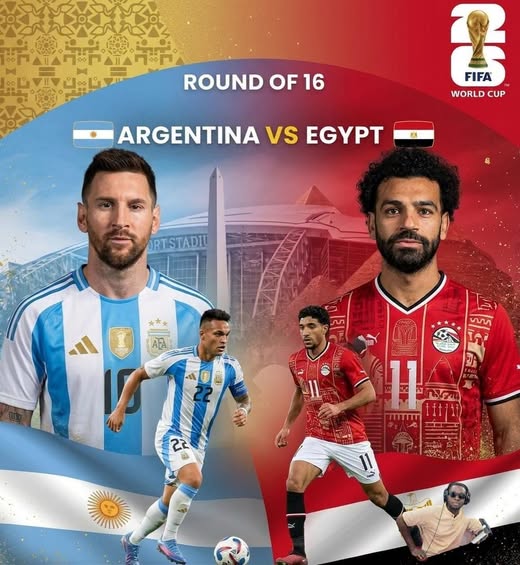
Just when we thought England and Mexico had given us the match of the tournament, Argentina and Egypt arrived and took the World Cup to another level.
It was football played at Formula One speed.
It was Fast & Furious with a football.
End to end.
Wave after wave.
Attack after attack.
You hardly had enough time to catch your breath before another chance appeared at either end.
This World Cup simply refuses to slow down.
As an African, however, I watched the closing stages with mixed emotions.
Pride.
Admiration.
And ultimately, disappointment and then, heartbreak .
Once again, an African team surrendered a commanding two-goal lead in the closing stages of a World Cup match.
I call it “The Final-Ten Fade.”
That painful period when victory appears within touching distance, only for concentration, composure or simply the relentless pressure of elite opposition to snatch it away.
Perhaps others will call it “The Eightieth-Minute Curse.” Or is it “The Near Success Syndrome”
Whatever we choose to name it, Africa must learn how to overcome it.
Egypt had Argentina exactly where they wanted them.
Their pressing was relentless.
Their movement unsettled the South Americans.
Their pace disrupted Argentina’s rhythm.
Before long, the Pharaohs were deservedly two goals ahead.
For a brief moment, Africa dared to dream.
Argentina looked rattled.
Disorganised.
Almost vulnerable.
Then came Lionel Messi.
He never looked hurried.
He never appeared frustrated.
He simply continued playing football.
From deep positions, he dictated the tempo.
He switched play effortlessly from right to left and back again, stretching Egypt until spaces inevitably began to appear.
Watching Messi at work was like watching a master weaver patiently creating a magnificent tapestry.
Every pass had purpose.
Every movement asked another question of the Egyptian defence.
Ironically, even after missing his second penalty of this World Cup, Messi remained completely unfazed.
That is the hallmark of greatness.
He refused to allow one missed opportunity to define his evening.
Instead, he kept believing.
He produced an assist.
Then, in the 83rd minute, he calmly swept home Argentina’s equaliser.
Still, Egypt fought on.
They defended.
They hoped.
They dreamed of extra time.
But football can be wonderfully cruel.
Deep into stoppage time, in the 93rd minute, Enzo Fernández arrived to score Argentina’s winner and complete one of the most dramatic comebacks of this World Cup.
Argentina 3.
Egypt 2.
Heartbreak for Africa.
Relief for South America.
Yet despite the defeat, I finished the match more optimistic about African football than ever before.
I have long supported CAF’s decision to stage the Africa Cup of Nations every two years.
Many criticised the policy.
I did not.
Today, the evidence is becoming increasingly difficult to ignore.
African football has improved dramatically.
Our players now compete regularly at the very highest level.
Our national teams are no longer content merely to participate.
They now expect to compete.
They now expect to win.
Morocco have reinforced that belief.
Egypt reinforced it tonight.
Cape Verde reinforced it before their courageous exit against Argentina.
Even in defeat, African teams are no longer making up the numbers.
They are forcing football’s traditional powers to produce their very best.
For that reason, I sincerely hope CAF maintains the biennial Africa Cup of Nations for a few more years.
Regular, high-quality continental competition is accelerating our development.
The results are already visible.
And so I make another prediction.
An African nation will lift the FIFA World Cup by 2030.
Not because of sentiment.
Not because of hope.
But because the evidence is unfolding before our eyes.
The quality is improving.
The confidence is growing.
The tactical discipline is evolving.
The belief is no longer borrowed.
It belongs to us.
Then came another image that reminded us why football remains the world’s greatest sport.
At the final whistle, Lionel Messi celebrated with tears of joy.
Barely twenty-four hours earlier, football had shown us a different kind of tears.
Those of Cristiano Ronaldo.
One legend wept because victory had rescued his dream.
The other because defeat had brought an extraordinary World Cup journey to an end.
Two icons.
Two different emotions.
One unforgettable tournament.
If this World Cup has taught us anything, it is this:
The gap between football’s traditional giants and its challengers is rapidly disappearing.
And Africa is no longer knocking on the door.
Africa has arrived.

Leave a Reply