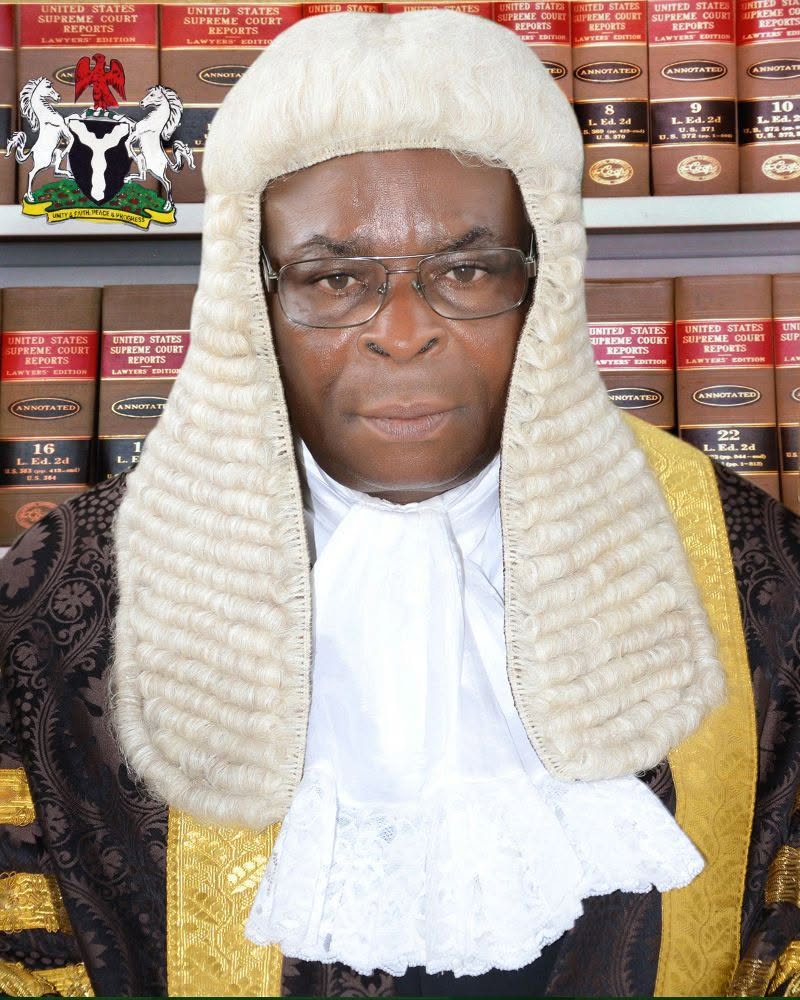
One of the things that messed the Judiciary up in this nation was the forceful removal of Justice Walter Nkanu Onnoghen as the Chief Justice of Nigeria by Buhari’s administration.
Since Justice Onnoghen was forcefully removed, the Judiciary has never truly recovered from the shock.
Many judges never imagined that such a thing was possible until it happened before their very eyes.
Before Justice Walter Onnoghen was removed, judges were more confident in carrying out their duties without fear of intimidation from political actors.
It was so because, although the Constitution of Nigeria never expressly granted judges immunity from political intimidation whenever they delivered judgments that did not align with the interests of the political class.
But somehow, they found a way to create that protection for themselves.
It all started when the Kwara State House of Assembly woke up on the morning of May 4, 2009, dressed in their best attires and headed straight to their hallowed chamber.
What was their mission that day?
It was to remove Justice Raliat Erelu Habeeb as the Chief Judge of Kwara State.
On whose orders were they acting?
They were acting on the instructions of Bukola Saraki, the then Governor of Kwara State, who had accused Justice Raliat of misconduct.
Acting under Section 292 of the Constitution, the House passed a resolution removing her as Chief Judge of the state.
Dr. Bukola Saraki, as Governor, did not even allow the ink on the resolution to dry before signing her removal into effect.
After all, it was his plan from the beginning.
But Justice Raliat refused to surrender.
She pursued her case all the way to the Supreme Court.
Her argument was very simple.
She acknowledged that Section 292 of the Constitution gave the Governor and the House of Assembly powers relating to the removal or suspension of a judge in cases of misconduct.
However, she argued that Nigeria already had a federal body specifically created to deal with judicial misconduct which is the National Judicial Council (NJC).
According to her, any allegation of misconduct against a judge must first be investigated by the NJC. Only after the NJC has investigated and recommended removal can a Governor or President lawfully act.
She reminded the Supreme Court of its earlier position in Nganjiwa v FRN, where the same principle was upheld.
Fortunately for her, the Supreme Court agreed.
The apex court reaffirmed that neither a State Governor nor a State House of Assembly can unilaterally remove a Chief Judge without first obtaining a formal recommendation from the National Judicial Council. It held that the NJC must always be the first port of call whenever allegations are made against a judicial officer.
As a result, Justice Raliat was reinstated.
From that moment, the political class learnt a valuable lesson.
They learnt how to respect judges and the Judiciary.
Then came the case of Justice Walter Onnoghen.
On April 18, 2019, Buhari woke up and suspended the Chief Justice of Nigeria on allegations that he had improperly declared his assets.
The Judiciary watched.
Judges watched.
They watched as their number one judicial officer was publicly humiliated and pushed out of office.
Yet, nothing happened.
Malami, who was the Attorney General at the time, knew how dangerous and improper it was to expose a sitting Chief Justice of Nigeria to the intimidation of political actors. He knew the implications.
Yet he encouraged it.
He even dragged Justice Onnoghen before the Code of Conduct Bureau without any recommendation from the National Judicial Council.
Justice Danladi Umar, who hurriedly tried and convicted him at the Code of Conduct Tribunal, also knew the implications. He knew it was improper to subject a judicial officer to disciplinary proceedings without first passing through the NJC.
Yet he willingly offered himself as a tool.
In the end, Justice Walter Onnoghen was humiliated, tried, convicted and removed, while the Judiciary stood by and did nothing.
That single event changed everything.
Today, many judges are extremely careful whenever a case involves the President or a Governor. They know that one wrong judgment, at least in the eyes of powerful political actors, could expose them to the same fate that befell Justice Walter Onnoghen.
This is one of the challenges of the common man today who hoped to see the Judiciary do their duties confidently no matter whose ox is gored.
This publication was written by Ekene Aninze Esq.

Leave a Reply