By Chris Osa Nehikhare | Publisher, From My Window
A Remembrance Day, a gathering of living legends, and a powerful reminder that Edo’s musical heritage must never be allowed to fade.
By Chris Osa Nehikhare
Publisher, From My Window
There are events you attend because duty demands your presence. There are others that unexpectedly take you on a journey through time.
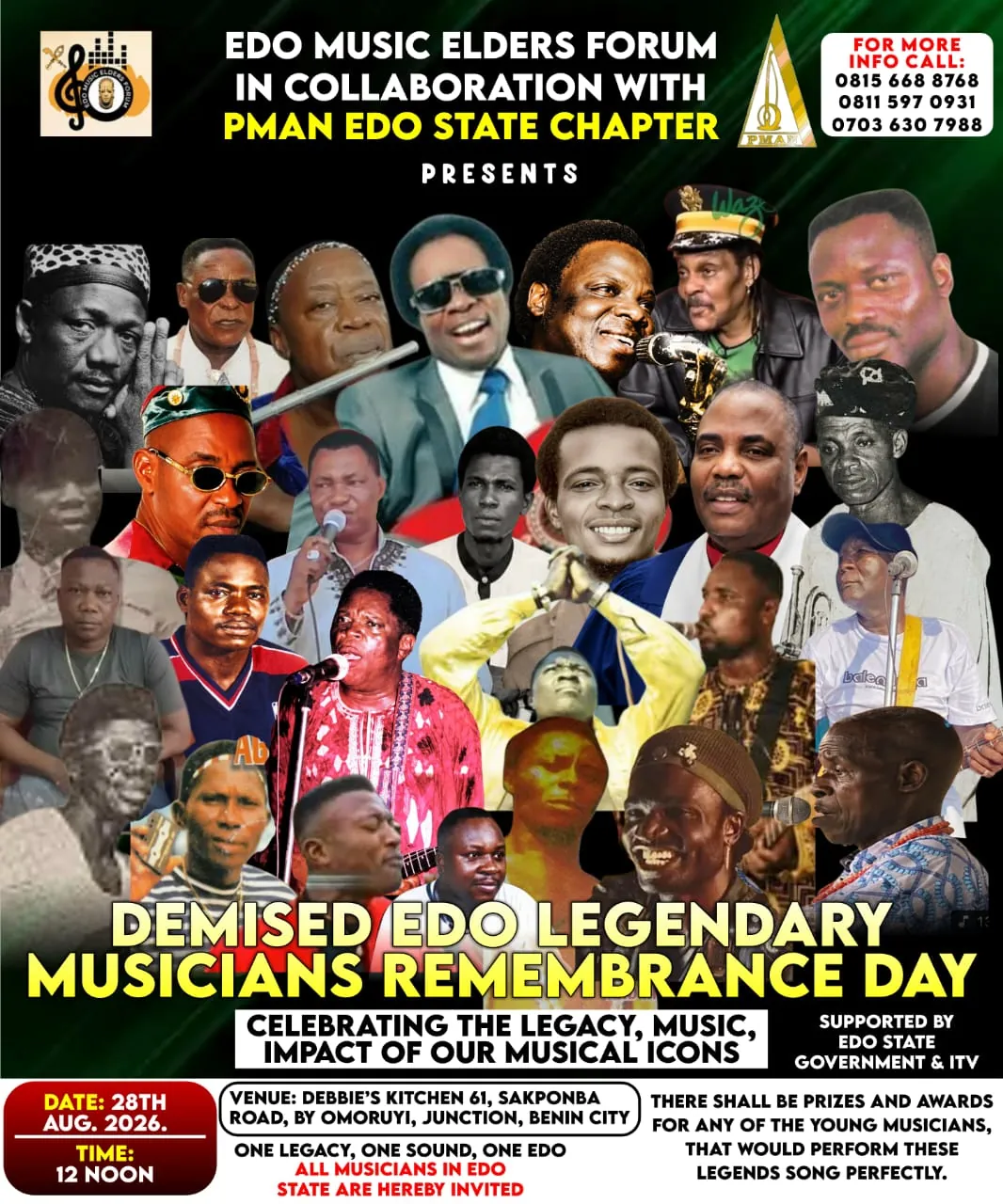
The Edo Music Elders Forum, in collaboration with the Performing Musicians Employers’ Association of Nigeria (PMAN), Edo State Chapter, recently held what it called a Remembrance Day for Our Demised Edo Legendary Musicians.
I attended representing His Excellency, Mr Godwin Obaseki, immediate past Governor of Edo State.
For me, however, it became much more than an assignment. It became an evening of memories.
It was an opportunity to remember men and women whose voices, instruments, compositions and performances formed part of the soundtrack of our lives. It was also an occasion to reflect on the extraordinary musical heritage that Edo State has given Nigeria and the world.
The Chairman of the Edo Music Elders Forum captured the essence of the gathering when he reminded us that the occasion was not merely one of mourning, but one of “remembrance, honour, celebration, and appreciation.”
We had not gathered simply to mourn those who were gone. We had gathered to celebrate what they left behind.
One important point in the Chairman’s address stayed with me.
Music, he reminded the gathering, is more than entertainment. It is an instrument of communication, education, unity and cultural preservation.
That statement could easily describe the history of Edo music. Our great musicians did much more than make people dance. Through their songs, they documented society. They celebrated achievement.They advised. They entertained. They preserved language, expressions and traditions. And, perhaps without consciously setting out to do so, they created an audio archive of Edo society across generations.
Long before social media, these musicians were our storytellers. Long before we began speaking so urgently about preserving our cultural heritage, they were already doing it—with guitars, drums, voices and lyrics.
As the Chairman warned in his address, a people who forget their heroes risk gradually losing touch with their history.
Perhaps particularly gratifying for me was the acknowledgement at the event of the efforts of the immediate past Edo State administration in recognising and celebrating our musical legends and supporting the Edo Music Elders Forum.
I was pleased not merely because I was there representing the former Governor, but because it demonstrated something that should become normal in our society. Governments come and go. Political parties win and lose elections. But our culture does not belong to a political party or administration. It belongs to the people.
When an administration makes an effort to preserve, promote and honour the cultural heritage of its people, the next administration should be able to build upon it. It was therefore encouraging that the Honourable Commissioner responsible for Culture, Tourism and the Creative Economy was present.
His remarks about continued support and encouragement, especially for the offspring of our departed musical legends who are themselves pursuing careers in music, were reassuring.
Because it was through those offspring that the evening suddenly became something quite extraordinary.
One after another, some of the children and successors of these great musicians took to the stage. And the years seemed to disappear.
Songs many of us grew up listening to came alive again. There was something deeply nostalgic about hearing those familiar rhythms performed live by a new generation. You suddenly remembered homes, parties, Obitos, old record players and those unmistakable sounds that once filled our communities.
These were not merely songs.
You could look around the gathering and almost see people travelling backwards in time.
Perhaps that was the most compelling demonstration of the Chairman’s assertion that although the voices of our departed legends may have become silent in the physical world, their music and messages continue to echo through generations.
We saw that echo before us. Their children were playing their music. The audience still knew the songs. People could still recognise the rhythms almost from the first notes. And suddenly the word legacy ceased to be an abstract expression.
We could see it. We could hear it.
One performer captured that sense of continuity particularly well.
Peter Uwaifo, popularly known by his stage name, Peter The Rock.
Peter is a nephew of the legendary Sir Victor Uwaifo. His father, Clement Uwaifo, popularly known as Clemico, was Sir Victor’s immediate elder brother and, significantly, was the first in the Uwaifo family to perform professionally before Victor Uwaifo.
That family history gives Peter The Rock’s performance an even deeper meaning.
What we witnessed was not merely a younger relative reproducing the style of a famous uncle. It was the continuation of a musical tradition that had already taken root in the Uwaifo family before Sir Victor became the international icon the world came to know.
Peter’s appearance, dress sense, mannerisms and stage presence naturally evoked memories of Sir Victor Uwaifo. But behind that resemblance was a broader family legacy stretching back through Clemico.
Peter The Rock performed Jolomi.
For From My Window, the moment had particular significance.
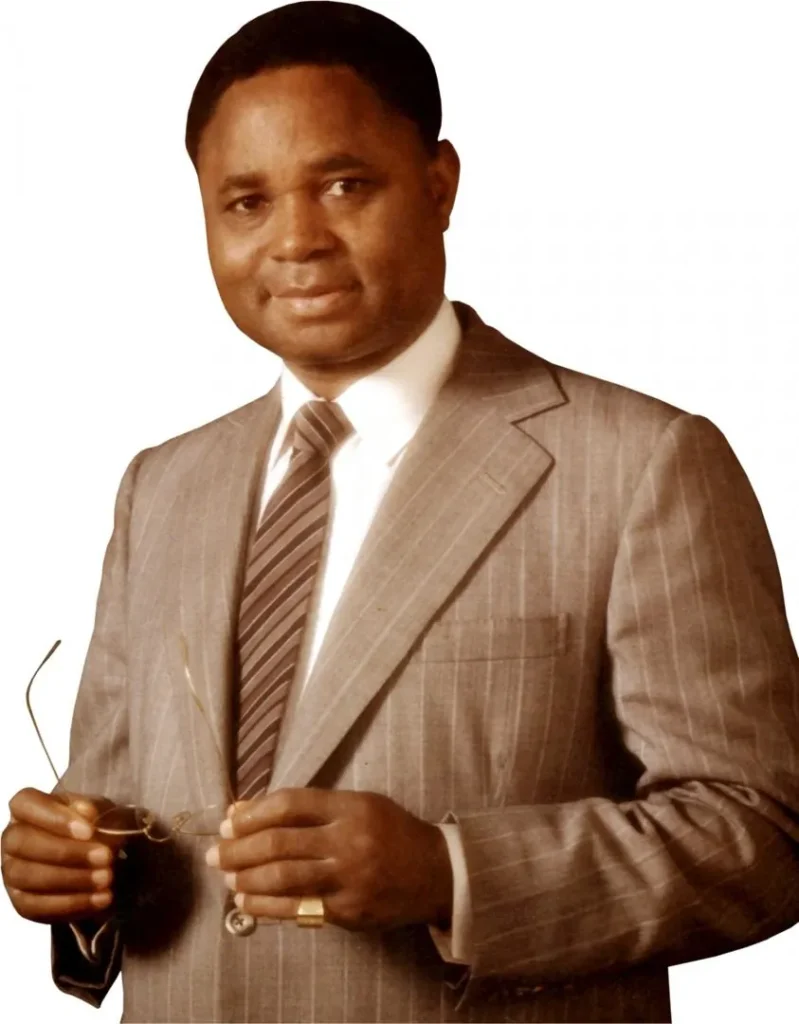
Sir Victor Uwaifo is one of the distinguished Edo personalities whose story we have documented in our Edo Icons: Legacy Series, a series established precisely because we believe the lives and contributions of remarkable Edo men and women who have passed on must be deliberately preserved for generations that may never have had the privilege of knowing them.
Watching Peter The Rock perform therefore reinforced an important point: legacy is not always preserved only in archives, books and photographs. Sometimes, it survives in families. It survives in performance.
Thankfully, the evening was not devoted only to those who have departed. Some of Edo’s living musical veterans were there.
Among those present were Akaba Man, Prince Mochichobay, General Miki Jaga, Adviser Abeso, Prof. Richard Ugiagbe, Fabomo, Papa Rostom, Nehizena and Prince Arthur Alile, amongst others.
Seeing them gathered together brought another thought to mind. We must resist our unfortunate habit of discovering the greatness of people only after they die.
These men are living libraries. There are stories locked inside them—stories about the early days of Edo music, recording studios, live bands, tours, promoters, instruments, friendships, rivalries and the evolution of sounds that travelled from Edo communities into homes across Nigeria and beyond.
Those stories should be recorded now. Their recordings should be digitised where necessary.
Young Edo musicians should have opportunities to interact with them. Because preserving our musical heritage cannot simply mean remembering the dead. It must also mean honouring and documenting the living.
Then came one of the evening’s most solemn moments. Candles were lit in remembrance of the departed legends. Prayers were offered for the repose of their souls.
For a gathering filled with music and nostalgia, it was an appropriately quiet moment. Each flame represented more than a musician who had died. It represented a life.
A body of work. An era.
And somewhere in that hall, each name and each familiar song probably awakened a different personal memory. That is the extraordinary power of music.
I left the event pleased, nostalgic and thoughtful.
The Edo Music Elders Forum and PMAN deserve commendation for creating a platform where remembrance goes beyond mourning and becomes an instrument for preserving history.
But their work also poses a challenge to all of us.
The Chairman appealed to the Edo State Government, corporate organisations, cultural institutions, well-meaning individuals and lovers of music to support programmes that preserve the memories and legacies of our cultural and musical icons.
I agree.
Our musical heritage is simply too important to be left to chance. Government has a role. The commitment expressed by the present administration towards encouraging the offspring of these legends and supporting PMAN (Performing Musicians Association of Nigeria, Edo State Chapter) is welcome and should be translated into sustainable programmes.
But government cannot do it alone.
Families, musicians, historians, broadcasters, publishers, universities, cultural organisations and private institutions all have roles to play.
And at From My Window, we have a role too.
Our Edo Icons: Legacy Series is our own modest contribution to that preservation.
We have already told the story of Sir Victor Uwaifo.
There are many more stories waiting to be told.
Indeed, looking around that hall at the living legends gathered before us, I found myself thinking that perhaps some of those stories should be told while their owners are still here to tell them themselves.
Because someday another generation will ask:
Who were these people?
What did they sing?
Why did they matter?
Why did our parents and grandparents become so excited whenever their songs were played?
We owe that generation an answer.
The candles that evening were lit for those who had departed. But then their children picked up the instruments.
They began to play. The familiar sounds returned. And something beautiful happened.
The legends lived again.
And for a few wonderful, nostalgic moments, so did a part of our youth.
From My Window | A view. An opinion. Our Reality.
Leave a Reply