By Chris Osa Nehikhare | Publisher, From My Window
Football has always had controversies. Bad refereeing. Dubious penalties. Transfer scandals. Match-fixing allegations. Owners behaving badly.
But what has unfolded around Manchester City is different.
It goes to the very heart of what makes competitive sport worth watching: the belief that everybody is playing by the same rules.
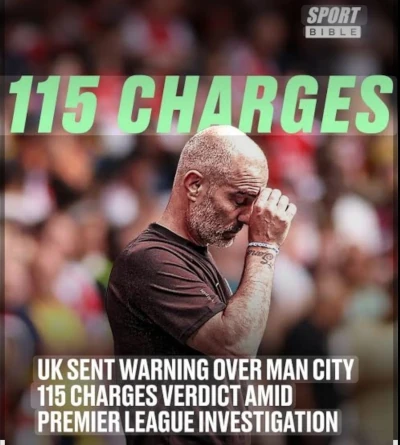
An independent Premier League commission has now found Manchester City guilty of the serious financial-rule charges brought against the club covering nine seasons between 2009/10 and 2017/18.
The findings are extraordinary.
According to the Premier League, arrangements described by the commission as “sham” contracts were used to artificially inflate revenues and reduce costs. The commission also found that accounts were misstated, the true state of the club’s finances was concealed from auditors and football regulators, and that City would have significantly breached Premier League and UEFA spending limits had the transactions been properly reported.
Manchester City strongly rejects the findings and has indicated that it will appeal. No punishment has yet been imposed.
That process must be allowed to run its course.
But there is another question that troubles me almost as much as the offences themselves.
How did this go on for so long?
This is the English Premier League.
This is perhaps the most sophisticated domestic football competition in the world.
Today football can tell us how many kilometres a player ran, his top speed, expected goals, expected assists, touches in the opposition box, passing angles, heat maps and virtually every movement made during 90 minutes.
Clubs are analysed to fractions and percentages.
Yet serious financial irregularities were found to have stretched across nine seasons.
Of course, tracking a footballer’s sprint is not the same thing as forensic accounting. Hidden agreements cannot necessarily be discovered by an algorithm. And the eventual Premier League investigation itself was enormously complicated.
But that cannot completely answer the question.
Financial regulations existed. Clubs submitted accounts. Sponsorship arrangements were declared. Spending limits existed precisely because financial power can translate into sporting advantage.
If the regulatory system could not identify problems of this magnitude earlier, then English football must examine not only Manchester City’s conduct but also the effectiveness of its own monitoring systems.
Because financial cheating in football — where ultimately established — is not victimless.
It potentially changes everything.
A club able to spend beyond limits available to its competitors can buy a better player.
That player can score the goal that wins a match.
That match can decide a championship.
That championship can determine Champions League qualification, prize money, sponsorship income and the ability to attract still more elite players.
The advantage compounds.
And somewhere else another club pays the price.
During the period covered by the serious breaches, Manchester City won Premier League titles in 2011/12, 2013/14 and 2017/18.
Think about the teams on the other side of those races.
Manchester United lost the 2011/12 championship on goal difference after perhaps the most dramatic final day in Premier League history.
Liverpool finished two points behind City in 2013/14.
Manchester United finished second in 2017/18.
This does not automatically mean those championships will now be awarded to the runners-up. That is a separate question for the disciplinary process, and sanctions have not yet been determined.
But football cannot pretend those clubs and their players have no legitimate reason to feel aggrieved.
A medal handed over many years later cannot recreate the moment.
You cannot recreate the lap of honour.
You cannot return supporters to a stadium and allow them to celebrate a championship they believed they had lost.
You cannot recreate the commercial opportunities that followed.
You cannot reconstruct careers.
And the damage potentially goes further than championships.
What about clubs that missed Champions League qualification?
What about prize money?
What about managers who were dismissed after failing to meet expectations?
What about clubs that lost players because they could not offer Champions League football?
What about transfer targets who chose one club over another?
What about the cascading financial consequences of finishing one position lower?
Football is an ecosystem. Alter one part of the competitive balance and the effects travel much further than a league table.
That is why financial rules matter.
They are not boring regulations written for accountants.
They are part of the rules of the competition.
We would never accept a team fielding 12 players because it could afford an extra footballer. We would never say a club could enlarge its goal while everybody else played with regulation dimensions.
Financial rules may be less visible, but their purpose is similar: to establish boundaries within which everybody competes.
And that brings me back to the Premier League.
It deserves credit for pursuing an enormously difficult case against one of its biggest and most powerful members. The investigation lasted years, the legal arguments were complex, and the commission had a huge volume of evidence to consider.
But enforcement after the event is only part of regulation.
Detection matters too.
The Premier League must therefore ask itself an uncomfortable question.
If breaches this serious can persist over such a long period before being exposed, is the financial monitoring system sufficiently equipped to protect the competition in real time?
Because justice delayed in sport carries a peculiar cruelty.
The match has already been played.
The trophy has already been lifted.
The champagne has already been sprayed.
The photographs have entered history.
And those who may have been denied their moment can never completely get it back.
Manchester City will exercise its right of appeal. The eventual punishment, if the findings survive that process, must be determined independently and according to the rules.
But whatever happens next, English football should learn something from this episode.
Financial regulation cannot merely discover yesterday’s wrongdoing.
It must be capable of protecting today’s competition.
Otherwise, years from now, supporters may again discover that what they thought they were watching was not quite the contest they believed it to be.
And for a sport built ultimately on trust, that may be the greatest loss of all.
From My Window | A view. An opinion. Our Reality.





Leave a Reply