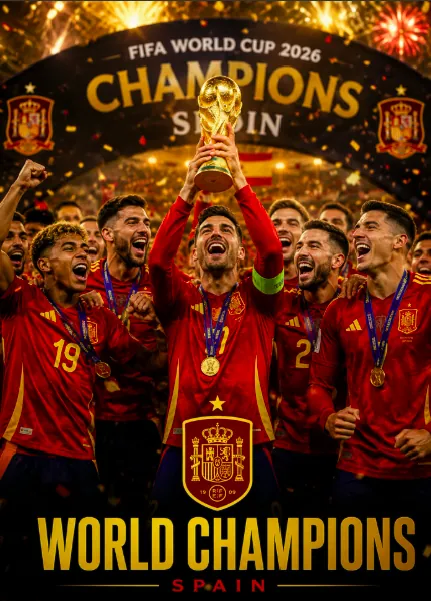
Before the first ball was kicked at the 2026 FIFA World Cup, I made my prediction.
Spain.
The statistics pointed me in their direction. The data pointed me in their direction. My assessment of the quality, balance and technical ability within the squad pointed me in their direction.
I had Argentina close behind.
Then the tournament began, and something happened to me that happens to every football lover: emotion got in the way of analysis.
England became my boys. Hope replaced statistics. Passion began to argue with data. I wanted to believe.
But football, eventually, has a way of bringing us back to reality.
And so, when the final whistle eventually sounded after a gruelling World Cup final, Spain had defeated defending champions Argentina 1–0 after extra time to become champions of the world for the second time. Ferran Torres delivered the decisive goal, and a tournament that began with Spain among the favourites ended exactly where our pre-tournament analysis suggested it might—with La Roja holding the World Cup.
Spain are worthy champions.
Very worthy champions.
But perhaps the greater story is not simply that Spain won the World Cup.
It is how Spain have come to dominate world football.
Today, Spain occupy a remarkable position. They are men’s world champions. Their women are world champions. The men’s team came into this World Cup as European champions. Spain have become the first nation to simultaneously hold both the men’s and women’s senior World Cups, while their recent success extends across other international competitions and age groups.
That cannot be an accident.
It is a philosophy.
It is a system.
It is a football culture.
Spain have spent years developing an identity built around the football itself. Technique. Intelligence. Movement. Possession with purpose. Players comfortable receiving the ball under pressure. Midfielders who understand space. Defenders expected to play football rather than merely destroy attacks.
There is also a collective understanding that no individual is bigger than the system.
The roots stretch back through generations and through the influence of a football culture associated with Johan Cruyff, Barcelona’s development of positional play and the subsequent evolution of Spanish coaching. But this Spain is not merely a reproduction of the great tiki-taka teams of yesterday. The philosophy has evolved.
This Spain can keep the ball.
But they can also hurt you quickly.
They can pass around you.
They can go through you.
They can stretch you with width.
And, perhaps most importantly, when they lose the ball, they want it back.
Quickly.
That is what makes the modern Spain so difficult to play against.
Their possession is not cosmetic. It is defensive and offensive at the same time. If you cannot get the ball, you cannot hurt them. And when you finally get it, you often find yourself under immediate pressure.
France discovered this in the semi-final.
On paper, France had everything required to trouble Spain—power, pace, individual brilliance and an attack capable of frightening any defence in the world.
Spain neutralised them.
The 2–0 scoreline told only part of the story. Spain exploited French errors, maintained control through slick passing and pressed relentlessly. Goals from Mikel Oyarzabal and Pedro Porro completed what FIFA described as a deserved victory.
Then came Argentina.
The defending world champions.
The team that had broken my English heart.
The team of a certain Mr Messi.
After watching Argentina overwhelm England in that extraordinary second half of the semi-final, I had developed an even greater respect for them. I had watched Messi transform himself from what appeared to be a detached observer into the conductor of an Argentine orchestra.
Argentina were experienced.
They were physical.
They were champions.
And they had Messi.
If France represented Spain’s examination of athleticism and attacking power, Argentina represented something different: mentality, resilience, experience and the knowledge of how to win the biggest football match on earth.
Spain neutralised them too.
It took extra time. It took patience. It took courage.
But Spain never abandoned Spain.
That, for me, is the lesson of this World Cup.
They did not suddenly decide that because Messi was standing on the other side of the pitch, they had to become Argentina.
They remained Spain.
They trusted their football.
They trusted their structure.
They trusted one another.
And eventually, after wave upon wave of effort, the breakthrough came. Ferran Torres scored in extra time and Spain defeated Argentina 1–0. One account of the final recorded the winner as Spain’s 20th attempt on goal—a statistic that speaks to persistence as much as dominance.
That is the mark of a great football nation.
Spain’s journey through the knockout rounds told its own story: Austria were beaten 3–0 in the Round of 32. Portugal fell 1–0. Belgium were overcome 2–1 in the quarter-final. France were comprehensively dispatched 2–0 in the semi-final. Then came the ultimate test—the defending champions Argentina—and Spain prevailed 1–0 after extra time.
Portugal.
Belgium.
France.
Argentina.
That is not a World Cup handed to anyone.
That is a World Cup earned.
And perhaps that is why this victory should be celebrated beyond the players who lifted the trophy.
Spain have demonstrated what can happen when a country develops a football philosophy and remains committed to it.
Of course, great players matter. Coaches matter. Generations change. Football evolves.
But Spain appear to have built something deeper.
There is a recognisable Spanish footballer.
Technically comfortable.
Tactically educated.
Uncomfortable with surrendering possession.
Prepared to press.
Prepared to move.
Prepared to think.
And above all, prepared to play as part of a collective.
The names may change, but the philosophy remains.
That philosophy now sits at the summit of world football.
The women are world champions.
The men are European champions.
And now, the men are world champions too.
For me, there is also a small personal satisfaction.
Before the World Cup, I looked at the teams, examined the evidence and picked Spain.
Then England arrived and stole my heart.
Football does that.
My heart wanted England.
My head had said Spain.
In the end, my head won.
And so did Spain.
Congratulations, La Roja.
Champions of the world.
Not merely because they had the best players.
Not merely because they defeated Argentina.
But because, when the pressure was greatest and the opposition strongest, they remained faithful to who they are.
Spain came to the World Cup with a philosophy.
They left with the trophy.
And we predicted it.


Leave a Reply