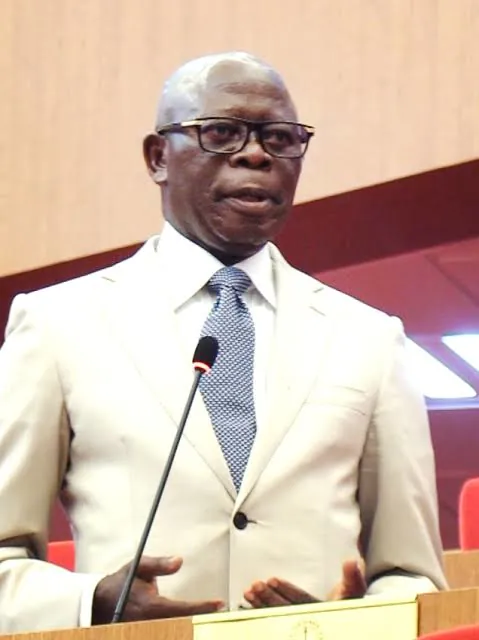
I listened with considerable interest as Distinguished Senator Adams Oshiomhole publicly challenged the Honourable Minister of Works, David Umahi, over the deplorable condition of federal roads in Edo State. The Senator reportedly questioned why new federal road projects are being initiated in other places while critical arterial roads in Edo remain abandoned and, in many cases, virtually impassable.
It was a welcome intervention. But it was also one that carried a strong sense of irony.
Less than two years ago, the Edo State Government repeatedly raised the alarm over the deteriorating condition of these same federal roads. We argued that roads such as the Benin–Asaba Road, Benin–Sapele Road, Benin–Abraka Road and the Edo–Kogi Road had become economic liabilities, threatening lives, businesses and the strategic position of Edo as Nigeria’s transportation gateway.
We also complained that the Federal Government would neither undertake the necessary repairs with the urgency they deserved nor allow the Edo State Government to intervene with the expectation of reimbursement, an arrangement that had been adopted on several occasions by previous administrations.
Rather than addressing the substance of those concerns, the conversation quickly descended into politics. Genuine complaints about infrastructure were dismissed. Legitimate concerns were interpreted through partisan lenses. Those who spoke out were criticised instead of the problems being solved.
Today, those same roads remain in distress.
That is why this moment should serve as an important lesson. Public infrastructure should never become a casualty of political rivalry. A failed federal road does not ask whether the motorist is APC, PDP or Labour Party. Every commuter suffers the same potholes. Every business bears the same increased transportation costs. Every family faces the same risks of accidents, delays and insecurity.
Development cannot flourish where politics consistently takes precedence over governance.
The Honourable Minister of Works also has questions to answer.
Over the past few years, several assurances have reportedly been given regarding federal road projects affecting Edo State. Citizens have been promised rehabilitation, reconstruction and timely intervention. Yet many of the state’s most strategic federal highways remain in unacceptable condition.
Governments should ultimately be judged not by promises made but by promises fulfilled. Edo people deserve clear explanations, realistic timelines and visible progress. These roads are not luxuries. They are national economic assets connecting the South-South, South-East and Northern Nigeria.
Neglecting them carries consequences far beyond Edo State.
Senator Adams Oshiomhole equally deserves credit for eventually speaking up. It is never easy for a serving Senator belonging to the ruling party to publicly challenge a Minister from the same administration. In that respect, his intervention required political courage.
However, courage delayed often comes at a cost.
When these concerns were first raised, a broader bipartisan voice from Edo could have strengthened the case for urgent federal intervention. Unfortunately, political divisions appeared to overshadow the larger public interest. What was presented then as partisan criticism has now become an undeniable reality.
This is not the time to trade accusations. It is the time for reflection.
If there is one appeal I would respectfully make to Senator Oshiomhole, it is this: acknowledge that perhaps politics got in the way when Edo needed united advocacy. Leadership is not diminished by admitting that a different approach might have better served the people. On the contrary, the ability to recognise missed opportunities often strengthens public confidence.
An apology is not a sign of weakness. It is a demonstration that the interests of the people rise above political calculations.
The greatest lesson from this episode is simple.
Federal roads belong to Nigerians, not political parties. They should never be used as instruments of reward or punishment. Every administration, regardless of party affiliation, deserves equitable treatment when advocating for infrastructure that serves the public.
Edo’s roads cannot vote.
But they speak every day through broken vehicles, delayed journeys, lost investments and lives unnecessarily endangered.
It is time for less politics, more responsibility, and above all, roads that are worthy of the people who depend on them.

Leave a Reply