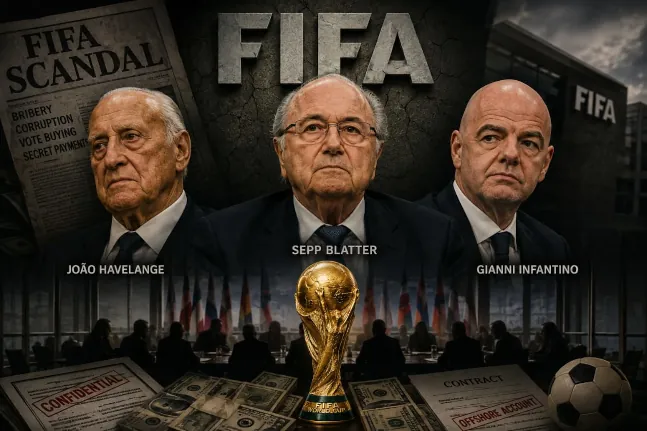
It’s Not the Men… It’s the System
Yesterday, I posed a question that has lingered over world football for decades.
Is the FIFA presidency a poisoned chalice?
From João Havelange to Sepp Blatter and now Gianni Infantino, every era has begun with optimism and ended amid controversy. Three different men. Three different personalities. Three different visions. Yet history seems determined to tell the same story.
That raises a more profound question.
What if the problem is not the men? What if the problem is the office itself?
We often comfort ourselves by believing that replacing one leader with another will solve an institution’s problems. It is an attractive idea because it is simple. But history repeatedly teaches us that when the same outcomes occur under different leaders, it is time to examine the system rather than merely the individuals.
The FIFA presidency is arguably the most powerful office in world sport. Its holder presides over more than 200 national football associations—more members than the United Nations. He oversees an organisation that generates billions of dollars from television rights, sponsorships, licensing, marketing and global competitions. He influences where the World Cup is played, how development funds are distributed and, in many respects, the future direction of football itself.
That is an extraordinary concentration of power.
Yet perhaps FIFA’s most fascinating feature is also one of its greatest vulnerabilities. Every member association has one vote.
Germany has one vote.
Brazil has one vote.
England has one vote.
Nigeria has one vote.
So do San Marino, Guam, the Seychelles and the Cook Islands.
On the surface, that appears to be the purest expression of democracy. Every nation, regardless of size or footballing pedigree, has an equal voice. But democracy without strong safeguards can easily become politics.
To become FIFA president, a candidate does not merely need the support of football’s traditional giants. He must convince more than a hundred associations spread across every continent. That requires endless campaigning, diplomacy, promises and relationships. Development programmes become campaign tools. Infrastructure projects become political currency. Football administration begins to resemble international electioneering.
None of this is necessarily illegal. But it creates incentives that can blur the line between genuine development and political patronage.
For many smaller football nations, FIFA grants are essential. They build pitches, train referees, support youth football and strengthen local leagues. Without that assistance, football in many countries would struggle to survive.
When the same office that distributes billions in development funding also depends on the votes of those receiving the funds, perception alone can become a problem. Even where decisions are made in good faith, scepticism is almost inevitable.
Modern football bears little resemblance to the sport João Havelange inherited in 1974. Television rights have become global commodities. Sponsors compete for association with the World Cup. The Club World Cup has become a major commercial enterprise. Women’s football is experiencing unprecedented growth. Digital media has opened entirely new revenue streams.
Every expansion of FIFA’s competitions brings not only more football but also more money, more influence and greater political importance. Success has made FIFA immensely wealthy. But wealth, without equally strong accountability, often creates temptation.
History is filled with institutions that accumulated enormous resources only to discover that governance had failed to evolve at the same pace. Banks. Corporations. Governments. International organisations. The lesson is always the same: systems designed for modest organisations often struggle when those organisations become global giants.
That is why changing presidents, while necessary at times, cannot by itself guarantee lasting reform. The next president will inherit the same structure. The same voting system. The same commercial pressures. The same political expectations. The same concentration of influence.
Without structural reform, history risks repeating itself.
What then should change?
Perhaps presidential terms should be limited to a single fixed term, reducing the temptation to govern with one eye on re-election. Perhaps development funding should be administered with greater institutional independence, ensuring that financial assistance is clearly separated from electoral politics.
Perhaps independent ethics and governance bodies should have stronger powers, greater transparency and genuine autonomy from FIFA’s executive leadership.
Perhaps World Cup bidding should continue to evolve towards even greater openness, allowing supporters and stakeholders to understand not only who won but why they won.
Above all, FIFA must remember a simple truth. It does not own football.
It merely holds it in trust.
The game belongs to the little boy kicking a ball on a dusty street in Benin City.
It belongs to the girl dreaming of playing in the Women’s World Cup.
It belongs to the supporters who save for years to attend one World Cup match.
It belongs to the millions who laugh, cry and celebrate because football has an unmatched ability to unite humanity.
The president of FIFA is only its temporary custodian. Perhaps that is the lesson history keeps trying to teach us.
Institutions should never depend upon the virtue of extraordinary individuals. They should be designed to restrain ordinary human weaknesses. That is the true purpose of governance.
And until FIFA reforms not merely its presidents but the presidency itself, the world’s most prestigious job in football may continue to carry a burden that no individual, however capable or well-intentioned, can escape.
Perhaps the FIFA presidency is not cursed.
Perhaps it is simply a mirror.
A mirror that reflects what happens whenever immense power, immense wealth and insufficient institutional restraint converge.
Football deserves better. Not because the game is perfect. But because the beautiful game deserves beautiful governance.
Leave a Reply