August is traditionally a month in which the world celebrates young people. International Youth Day gives us an opportunity to speak about their aspirations, challenges and place in society.
But this August, my thoughts have returned to a particular group of young Edo people I encountered four years ago.
I call them, affectionately, the Class of 2022.
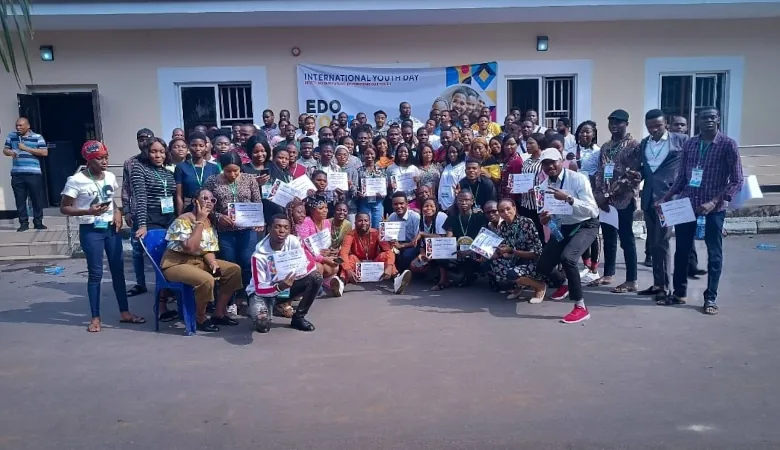
In 2022, while serving as Edo State Commissioner for Youth and Humanitarian Affairs, I had the privilege of organising what was then the first Edo Youth Colloquium as part of our activities marking International Youth Day.
It became much more than an event.
For about a month, I interacted closely with young Edo people from different backgrounds, interests and communities. We talked. We listened. We argued. We exchanged ideas.
And I learnt.
I was particularly proud to be Edo.
The colloquium included four breakout sessions facilitated by professionals in agriculture, arts and the creative sector, science and technology, and employability.
These were not subjects chosen merely to fill a programme.
They represented questions already occupying the minds of young people.
Where will the jobs come from?
How can agriculture become a business rather than merely subsistence?
What opportunities are emerging from technology?
How can Edo’s enormous creative talent become an economic asset?
What skills will tomorrow’s workplace require?
Listening to those young people changed some of my own perceptions.
They were curious. They were ambitious. They asked questions. They wanted opportunities. Many understood that the world was changing rapidly and that Edo could not afford to be left behind.
As part of that year’s celebration, we also held the first joint session of the Edo and Delta State Youth Assemblies.
It was a remarkable experience.
For me, however, the greatest value of that month was not the ceremonies. It was access to the thoughts of young people and the opportunity to understand how they saw their future.
Many of those young men and women remain in contact with me today.
Some have since graduated from university. Some have completed their National Youth Service. Others are presently serving. Some have entered employment, business and professional life.
Life has happened to them.
They have grown.
And by 2028, the Class of 2022 will be six years older.
That is important.
The young person who attended a youth programme as a 20-year-old in 2022 will be 26 in 2028.
A 24-year-old will be 30.
The undergraduate of yesterday may by then be an engineer, teacher, farmer, entrepreneur, doctor, artist, programmer, civil servant or parent.
Their expectations will have changed.
So should their politics.
That is why the recent Osun election has made me think again about Edo youths and 2028.
Whatever our individual political sympathies, one lesson from elections should always interest democrats: participation matters.
When citizens participate in large numbers, democracy becomes more representative of the actual wishes of the people.
When they stay away, they surrender enormous power to those who turn up.
For Edo youths, that distinction could determine 2028.
We frequently describe young people as “leaders of tomorrow.” I have never particularly liked that expression. Tomorrow has a habit of being permanently postponed.
Young people are citizens today. They work today, pay taxes today, suffer the consequences of bad policies today. They are unemployed today, start businesses today and raise families today.
Why, therefore, should their political relevance always be postponed until tomorrow?
By 2028, Edo youths must understand that their greatest political weapon is neither violence nor social-media outrage.
It is the vote.
The numbers are potentially enormous. But numbers mean nothing if they remain at home.
A million dissatisfied people who do not vote can be politically weaker than a much smaller organised group that does. That is one of democracy’s simplest lessons.
You have to show up.
I want the Edo youth of 2028 to be different.
Education should make us more difficult to deceive. Exposure should make us more demanding. Experience should make us wiser. And integrity should determine what we are prepared to accept.
Education, in this context, goes beyond certificates. It is the ability to ask questions. Who is asking for my vote? What has he or she accomplished? What does this person believe? What is the plan for jobs? What is the plan for agriculture? Where does technology fit into the future of Edo? What will be done about education, healthcare and infrastructure? How will government attract investment?
And, critically: Can I trust this person?
The four subjects we discussed at that 2022 colloquium—agriculture, creativity, technology and employability will remain relevant in 2028.
Indeed, they may be even more urgent.
Young people should therefore demand candidates capable of discussing these issues intelligently rather than merely distributing slogans.
There is something else I hope the Class of 2022 carries into 2028.
Integrity.
We cannot demand honest government while selling our votes. We cannot condemn corruption and then accept election-day inducements as our own share.
The few thousand naira offered for a vote may solve today’s small problem. The government produced by that transaction could create problems lasting four years. Your vote is worth considerably more. It represents roads. Schools. Jobs. Hospitals. Security. Economic opportunity. And the future of your children. No young person should exchange all of that for what can barely buy a decent meal.
There was something I felt repeatedly during that month-long engagement in 2022.
Pride.
I was proud of the young people I met. And proud to be Edo. That pride should mean something politically.
We are heirs to an extraordinary civilisation. Edo people have distinguished themselves in academia, business, medicine, engineering, arts, sports and public service across Nigeria and around the world.
Surely, therefore, we should demand excellence from those who seek to govern us. Being proud to be Edo must mean refusing mediocrity. It must mean saying that whoever seeks to govern this state must possess the character, capacity and intellectual preparedness worthy of its people.
Party affiliation will matter to politicians.
But Edo must matter to everybody.
The Class of 2022 Has Grown Up
I look at the photograph from that 2022 International Youth Day and wonder where all those young faces will be in another two years.
Some will be married. Some will have children. Some will own businesses. Some will have become employers. Some will be building careers. Some may even be seeking elective office themselves.
But almost all will have something important in common. They will have a stake in what Edo State becomes.
The young people I met in 2022 impressed me with their intelligence, ambition and curiosity.
In 2028, I want them and the much larger generation they represent to add something else:
political courage and responsibility.
You must come out and vote.
Not because somebody paid you or threatened you or because an elder instructed you.
But because you have examined the choices and decided what you believe is best for Edo State.
That would be a genuine youth revolution. Not youths carrying weapons for politicians, insulting one another on social media or waiting outside the homes of political benefactors.
But educated, exposed, confident young Edo men and women quietly walking into polling units and determining their own future.
The Class of 2022 will be fully grown by 2028. So will thousands who were even younger when we gathered four years ago.
They can be the game changers.
And perhaps that is the greatest lesson of this August: The future does not simply belong to the youth.
The future belongs to the youth who show up to claim it.

Leave a Reply