An article by Chris Osa Nehikhare | Publisher, From My Window
About twelve years ago, one of my younger brothers got married traditionally in Ekwulobia, Anambra State.
Our entourage was anything but small: four Toyota Hummer buses, one Coaster bus and about six other vehicles. My father, a retired military officer, led the delegation.
There was no Hilux escort. No MOPOL. No soldiers. Just family and friends travelling to celebrate a wedding.
We departed from our family compound in Eguadase, Benin City, at about 7am.
We arrived in Ekwulobia, participated fully in an elaborate and culturally rich traditional marriage ceremony, ate, drank, celebrated and watched two families become one.
By about 3pm, the ceremony was over.
Between 3.30pm and 4pm, our convoy began the journey back to Benin.
By about 7pm, we were back in Eguadase.
Benin to Ekwulobia. A traditional wedding ceremony. Ekwulobia back to Benin.
All in one day.
Nobody considered it extraordinary.
It was simply a journey.
Then Came Akpo
On August 22, 2026, we had another reason to travel to Anambra State, this time to Akpo, for the burial ceremony of my cousins father.
Akpo actually occupies a special place in my childhood memories. It was the first place I knew by name in Eastern Nigeria.
My aunt, my father’s sister, married from Akpo. Every Christmas, my cousins and their parents would travel there and return with stories that made us want to experience Christmas in Akpo ourselves.
We always wanted to go with them. We never did.
Perhaps our parents would have been lonely without us. Or so I thought. Lol.
Years later, I eventually visited Akpo for one of my cousin’s wedding. Like our Ekwulobia trip, it was an easy same-day journey.
Ekwulobia and Akpo are about 10 minutes drive apart.
This time, however, we were going for a much sadder reason: to pay our last respects to a wonderful in-law and to stand with our cousins as they laid their father to rest.
The funeral was well choreographed. I discovered that the community apparently has a template that must be followed, or else you risk being fined!
It wasn’t extravagant. It was dignified, classy and respectful.
The ceremony was beautiful.
But this story is not really about the funeral.
It is about getting there.
And, ultimately, about getting home.
Before leaving Benin, we already knew that the bypass end of the Benin–Agbor Road was virtually on lockdown.
Videos had circulated showing motorists trapped for hours in seemingly endless traffic. The situation around the Benin end was terrible, while the Agbor–Umunede axis presented another nightmare.
Some of my relatives were understandably reluctant to make the journey. Our entourage this time was far more conservative than twelve years ago: just one Coaster bus and a Sienna van.
I believed we could beat the traffic by avoiding the notorious sections altogether.
We would use the Benin–Abraka axis, take the Ugbokirima/Ogan route, pass through my village, Evboehighae, and reconnect with our journey from there.
It seemed like a clever plan.
And early that morning, it worked.
For a while.
Eventually, however, we encountered the familiar Nigerian road nightmare around the Asaba–Onitsha Head Bridge axis.
We finally arrived in Akpo at about 2.30pm.
Think about that for a moment.
Twelve years earlier, we could leave Benin at 7am, travel to Ekwulobia, attend an entire traditional marriage ceremony and begin returning home around the same time that we were only just arriving in Akpo on August 22, 2026.
That is not progress.
The bigger shock came on our return journey.
We left Akpo on August 23, early enough to reasonably expect to arrive back in Benin that same day.
We were wrong.
By then, even our supposedly clever alternative route was no longer a secret.
The articulated trucks had discovered it.
Heavy trucks, trailers and other vehicles desperate to escape the disaster on the major highways had begun diverting onto roads never designed to carry such traffic.
Some broke down.
Others struggled through.
And in the process, they were destroying the roads.
Our quiet village routes had effectively become emergency interstate highways.
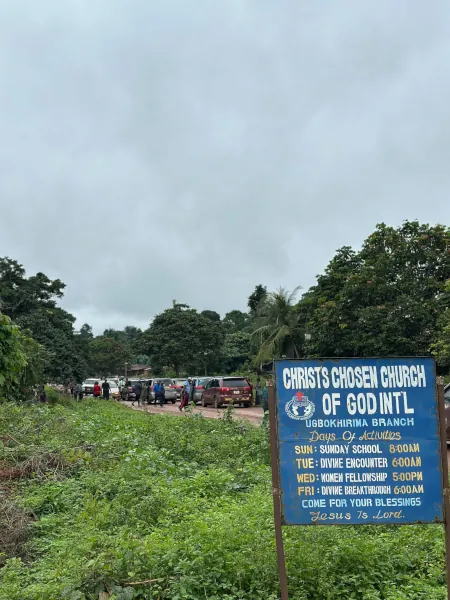
In sleepy Evboehighae, the consequences were unbelievable.
Traffic stretched into hundreds of vehicles.
Imagine that.
A community road suddenly carrying the consequences of the collapse of a federal highway.
Articulated vehicles were damaging village roads. Motorists desperate to escape the gridlock were driving through private compounds, creating makeshift routes and causing damage to people’s property.
People who had nothing to do with the failure of the federal highways were now paying the price for that failure.
This is how infrastructure collapse spreads. One major road fails. Traffic diverts. The alternative road deteriorates. Vehicles move into another community. That road collapses.
Before long, what began as the failure of one federal highway becomes a regional transportation crisis.
I have written previously that roads must never be politicised.
I maintain that position.
A road does not ask whether the person driving on it is APC, PDP, Labour or APGA.
A broken-down truck does not ask how you voted before blocking the highway.
And the trader whose goods cannot reach the market does not suffer differently because the road is labelled “Federal”.
When a major highway collapses, everybody suffers.
Businesses, Farmers, Transporters, Families, Communities, the economy and ultimately, government itself suffers a loss of credibility.
This is why I am increasingly uncomfortable with the tendency to treat legitimate complaints about infrastructure as political attacks.
The Benin–Auchi Road does not become motorable because a government official announces that work is ongoing.
The Benin–Agbor Road does not become acceptable simply because responsibility can be transferred to Abuja.
And Edo people do not experience less hardship because the road on which they have been stranded for hours carries the prefix “Federal.”
Edo State Government Must Speak Up. Let us be clear.
These are federal roads, and the primary responsibility for their rehabilitation rests with the Federal Government.
But that cannot become an excuse for the Edo State Government to behave like a disinterested spectator.
A state government is the first political custodian of the interests of its people.
When federal infrastructure within its territory deteriorates to the point where citizens are spending hours trapped on roads, businesses are losing money, vehicles are being damaged and village roads are being destroyed by diverted interstate traffic, the state government must speak.
It should be the loudest advocate for Edo people, it should be banging on the doors of Abuja.
It should be demanding timelines.
It should be publicly documenting the condition of these roads and the economic damage their deterioration is inflicting on Edo State.
Where interventions have been promised, Edo people deserve to know what was promised, by whom, at what cost and when the work will be completed.
That is not fighting the Federal Government. That is governing Edo State.
There is a difference between political cooperation and political silence.
No state government should pretend that all is well simply because the same political party controls Abuja and Osadebey Avenue.
Indeed, political alignment should make advocacy easier, not unnecessary.
The relationship between the Federal Government and Edo State Government should produce results for Edo people. It should not require Edo citizens to remain silent about their suffering for fear that telling the truth about our roads might embarrass somebody politically.
Roads must never be politicised. Neither should their failure be concealed by politics.
I keep thinking about that trip to Ekwulobia twelve years ago.
Seven o’clock in the morning, we left Benin. We travelled in a large convoy.
We celebrated a wedding.
We ate.
We laughed.
We participated in the ceremonies.
We left Ekwulobia around 4pm.
And around 7pm, we were home.
Nobody wrote an article about it.
There was nothing to write.
The road simply did what a road was supposed to do: It took us from one place to another.
Now consider what happened this time.
We left Akpo on August 23, 2026, early enough to reasonably expect to be home in Benin that same day.
We were not.
We arrived back in Benin on August 24.
A journey that twelve years ago allowed us to leave Benin in the morning, travel to Anambra State, attend an entire traditional wedding ceremony and return home the same evening has deteriorated to the point where simply returning from Anambra crossed into another day.
That, perhaps, tells the story better than any statistics ever could.
Development cannot only be measured by what we build anew.
Sometimes the most revealing measure of development is whether things that worked ten or twelve years ago still work today.
A journey that once connected families now exhausts them.
A highway that once carried commerce now destroys vehicles.
And village roads that once carried farmers, schoolchildren and motorcycles are being crushed under articulated trucks desperately searching for escape routes from failed federal highways.
This is not normal. And we must stop pretending that it is.
As I write this, we are finally back in Benin.
Tired. Frustrated. And grateful to have arrived safely.
But we should not have to celebrate surviving a road journey within our own country.
The Federal Government owes Edo State better roads.
But Edo State Government owes Edo people something too:
A louder voice.
It must acknowledge what its citizens are experiencing. It must stand up to federal neglect and demand urgent intervention. Not in whispers. Not behind closed doors alone. Openly, consistently and firmly.
That is not confrontation.
That is representation.
Because when your people leave Anambra State on one day and struggle through failed highways, broken-down articulated vehicles, endless gridlocks and damaged village roads before finally reaching Benin the next day, silence is no longer diplomacy.
It begins to look like acceptance.
And Edo people must never be asked to accept this as the new normal.
Twelve years ago, we went to Ekwulobia and came home.
This time, we went to Akpo.
Coming home became the story.
From My Window | A view. An opinion. Our Reality.


Leave a Reply