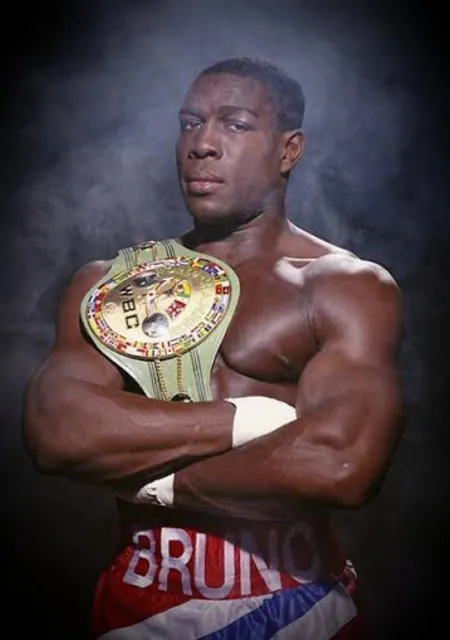
By Chris Osa Nehikhare | Publisher, From My Window
There are names you hear after many years and, almost immediately, they transport you back to another time.
Frank Bruno is one of those names.
For those of us who followed heavyweight boxing in the 1980s and 1990s, Bruno requires very little introduction.
Big. Powerful. Likeable.
And then there was that laugh. ĶThat unmistakable booming Frank Bruno laugh.
His conversations with legendary BBC boxing commentator Harry Carpenter became almost as entertaining as some of his fights. Bruno’s famous expression — “Know what I mean, ‘Arry?” — became part of British popular culture and was familiar even beyond the shores of Britain.
Here in Nigeria, we knew Frank Bruno too. Those were the days when heavyweight boxing commanded attention. Muhammad Ali had left enormous shoes behind, and those who came afterwards, Larry Holmes, Mike Tyson, Evander Holyfield, Lennox Lewis, Riddick Bowe and others ensured that heavyweight boxing remained compulsory viewing for millions around the world.
Somewhere in the middle of all that was Frank Bruno.
But recently, a simple question crossed my mind:
Whatever happened to Frank Bruno?
And that question has led us to this new From My Window series — WHERE ARE THEY NOW?
From Nigeria to Africa and across the world, we will occasionally go searching for those men and women who once occupied our television screens, dominated our sporting conversations, filled our dance floors or simply became part of our lives.
Where did life take them after the applause stopped?
Frank Bruno seems an appropriate place to begin.
THE MAN BRITAIN WANTED TO WIN
Frank Bruno was not necessarily the greatest heavyweight of his generation. But he may have been one of the most loved.
He turned professional in 1982 and quickly established himself as a frightening puncher. Victory after victory came, many by knockout, and Britain began dreaming of another heavyweight world champion. Bruno certainly looked the part. He was enormous, muscular and possessed a devastating right hand. But heavyweight boxing can be cruel.
In 1986, Bruno received his first opportunity to become world champion when he faced Tim Witherspoon for the WBA heavyweight title at Wembley.
He lost.
Three years later came another opportunity. Unfortunately, standing across the ring from him was one of the most terrifying heavyweight fighters the world had ever seen.
Mike Tyson.
Men entered the ring against him already looking defeated. His speed, aggression and punching power were frightening.
But Frank Bruno caught him.
For a brief moment, Mike Tyson was hurt. Suddenly, millions watching around the world wondered whether the impossible might happen. Could Frank Bruno actually beat Mike Tyson?
Tyson answered the question quickly.
He recovered, resumed his assault and stopped Bruno in the fifth round. Bruno had lost another world-title opportunity.
But he kept going.
By 1993, another opportunity arrived. This time the opponent was Lennox Lewis.
It was a fascinating contest. Two British heavyweights. Two enormous men. And the WBC heavyweight championship of the world at stake.
Bruno fought extremely well.
For significant periods of the contest, he appeared to be doing enough to finally become champion. Then heavyweight boxing happened.
Lewis hurt him and eventually stopped him in the seventh round.
Another opportunity gone.
Three attempts at becoming heavyweight champion.
Three defeats.
At 31, perhaps it was time to accept that some dreams were simply not meant to be.
Frank Bruno didn’t.
September 2, 1995. Wembley Stadium.
Frank Bruno stepped into the ring against WBC heavyweight champion Oliver McCall.
He was now 33 years old.
This was his fourth attempt at becoming heavyweight champion of the world.
For years, Britain had watched him try.
Witherspoon had stopped him.
Tyson had stopped him.
Lewis had stopped him.
Surely there could not be many opportunities left.
This time Bruno fought with the desperation of a man who understood exactly what the night represented.
He survived twelve rounds. Then came the judges’ decision.
Frank Bruno had done it.
World Heavyweight Champion.
Finally.
After all the disappointment and the nearly moments.
Frank Bruno was champion of the world. Sometimes persistence actually gets rewarded.
Unfortunately, Bruno’s reign would be brief. Six months later, in March 1996, he entered the ring for his first defence of the WBC title.
Waiting for him was an old acquaintance.
Mike Tyson.
This time there would be no tantalising moment when Bruno appeared capable of producing an upset.
Tyson overwhelmed him. Three rounds. It was over.
Frank Bruno had lost his world title. He would never fight professionally again.
His final record nevertheless tells us something about just how formidable a fighter he had been:
45 professional fights.
40 victories.
38 victories by knockout.
Only five defeats.
He had achieved his dream.
He had become heavyweight champion of the world. And he walked away. We assumed the fighting was finished.
We were wrong.
This is where Frank Bruno’s story becomes much more than a boxing story.
Retirement can be difficult for professional sportsmen.
For years, everything revolves around training.
Another fight. Another opponent.
Then one day, it stops.
For Bruno, life after boxing became extremely difficult. He struggled seriously with his mental health and was eventually diagnosed with bipolar disorder.
His difficulties became painfully public. There were hospitalisations. There were periods when he was sectioned under Britain’s Mental Health Act.
The newspapers that once celebrated the heavyweight champion now chronicled the struggles of the man behind the boxing gloves.
It must have been an extraordinary transition.
One moment, the world celebrates your physical strength.
The next, you are fighting an opponent nobody else can see.
Perhaps that was Frank Bruno’s toughest opponent.
But something important eventually happened. Bruno began talking. He spoke openly about mental health. About depression, bipolar disorder. About his hospitalisation and the difficulties he had experienced.
And in doing so, the former heavyweight champion began another fight.
This time, not merely for himself. For others.
Today, much of Frank Bruno’s life revolves around the Frank Bruno Foundation, an organisation established to support people experiencing mental-health difficulties. Its philosophy combines physical activity with mental wellbeing.
There is something wonderfully appropriate about that. The man who spent decades developing his body to withstand punches now uses physical fitness to help people strengthen their minds.
And Bruno has continued to speak publicly about his experiences. For men particularly, I think his story matters.
Many of us were raised in societies where men were expected to absorb everything.
Pain.
Fear.
Disappointment.
Anxiety.
The stronger the man, the less he was supposedly expected to admit that something was wrong.
Imagine, therefore, what it meant for a former heavyweight champion, a man whose entire public image had been built around strength to openly say:
I have struggled too.
That may ultimately become one of Frank Bruno’s greatest contributions.
Life, however, was not finished testing him.
In 2025, while travelling through Doha on his way to Thailand, Bruno became seriously ill.
He developed a high fever, became disoriented and reportedly blacked out.
He woke up in hospital.
There were initial fears about what might be wrong. He eventually spent about two weeks receiving treatment in Qatar before returning to Britain for further care.
Thankfully, he recovered.
And, in typical Frank Bruno fashion, he returned to the gym.
Today, Frank Bruno is 64.
He remains involved with his Foundation.
He continues to make public appearances.
He still trains.
And yes, the famous laugh is still there.
Looking back at Frank Bruno’s life, I find myself wondering which of his victories was actually his greatest.
Was it Oliver McCall at Wembley?
Perhaps.
That victory gave him something he had pursued for most of his professional life.
The WBC heavyweight championship of the world.
But maybe Frank Bruno’s most important victories came much later.
Getting out of hospital. Learning to live with bipolar disorder. Speaking publicly about mental illness or helping other people struggling with their own battles.
Those victories don’t come with championship belts.
But they are victories nevertheless.
And perhaps that explains why, decades after his final fight, people still feel enormous affection for Frank Bruno.
He became heavyweight champion of the world once.
But he became something else long before that belt was placed around his waist.
The People’s Champion.
Maybe that was always the more important title.
Frank Bruno is still fighting.
Only now, he is fighting a very different fight.
And that brings us back to the question that started this journey:
Whatever happened to Frank Bruno?
Well, we found him.
And I’m rather glad we went looking.
FROM MY WINDOW — WHERE ARE THEY NOW?
With Frank Bruno, we begin a new journey.
There are men and women whose names once dominated our conversations. Sportsmen and women we rushed home to watch. Musicians whose songs filled our homes. Actors and broadcasters whose faces became familiar to entire generations.
Then, somewhere along the way, we stopped hearing about them.
Some are Nigerians.
Some are Africans.
Others come from different parts of the world but became part of our own memories.
Every so often, From My Window will go looking for one of them.
Not simply to ask where they are.
But to discover where life took them after we stopped watching.
And already, I know the Nigerian whose story I want us to search for next.
Once upon a time, he was one of the fastest men on earth.
His name?
Chidi Imoh.
Where is he now?
Let’s find out.
From My Window | A view. An opinion. Our Reality.
Leave a Reply