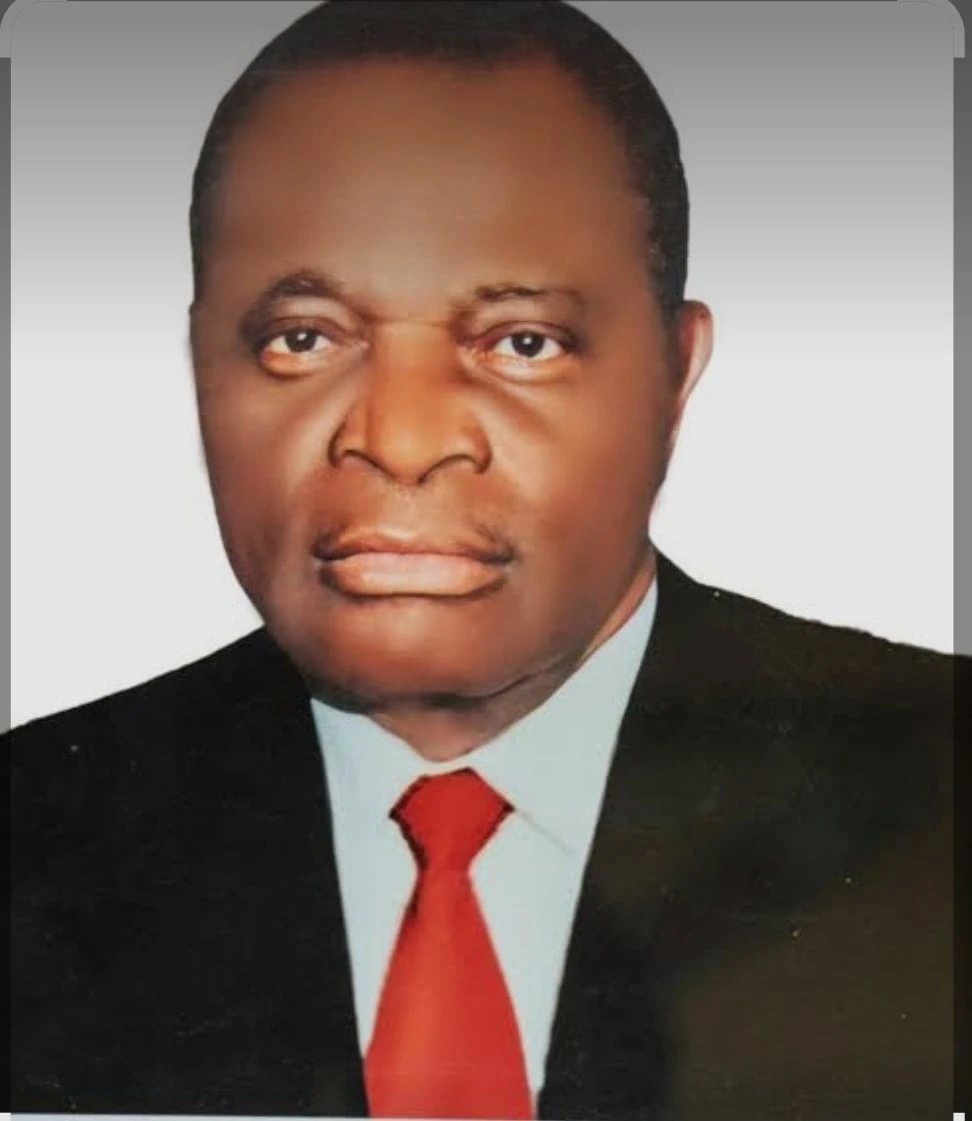
Uncle Parry and His Little Piece of Benin
By Chris Osa Nehikhare | Publisher, From My Window
Some people we encounter in life occupy two very different spaces in our memories.
There is the person the public knows. And then there is the person we were privileged to know.
To Nigeria, he was Parry Benjamin Osemwegie Osayande, retired Deputy Inspector-General of Police, former Chairman of the Police Service Commission, police reformer and one of the most recognisable senior police officers of his generation.
To me, he was simply Uncle Parry.
I visited his home many times. I sat with him, listened to his stories and, on more than a few occasions, shared a glass of whisky with him.
And his home had a name.
He called it:
“My Little Piece of Benin.”
Almost one year after his passing, I find myself thinking about those words.
For here was a man whose career carried him across Nigeria and beyond; a man who served at some of the highest levels of the Nigeria Police Force and whose voice continued to be heard on policing and national affairs long after he had retired.
Yet, at the end of all those journeys, there was Benin.
His little piece of it.
His home.
And perhaps that is where this story should begin.
Parry Osayande was born in Benin City on September 29, 1936. He attended Immaculate Conception College, Benin City, before entering the Nigeria Police Force and training at the Police College in Ikeja in 1960. Further professional training took him to institutions in Britain and, later, to the National Institute for Policy and Strategic Studies.
What followed was a policing career spanning more than three decades and a remarkable period of Nigerian history.
He served in Ibadan, Benin, Ogbomoso, Shagamu, Ikire, Lanlate, Ahoada, Ogoni, Port Harcourt and Lagos. He worked in administration, criminal investigation, operations, personnel and police finance. He commanded in Benue, Bendel and Cross River before eventually rising to the rank of Deputy Inspector-General of Police, with responsibilities that included Force Operations, Intelligence and Investigation.
This was policing in the field.
And Nigeria repeatedly called on him when the assignments were difficult.
For many Nigerians of my generation, the name Parry Osayande is inseparable from one of the most frightening chapters in the history of crime in the old Bendel State.
Lawrence Anini.
By 1986, Anini and his gang had turned armed robbery into something approaching a reign of terror. Their activities frightened communities, embarrassed the authorities and captured national attention.
Osayande was deployed to Bendel State during that crisis and became Commissioner of Police there. Under the operation he headed, the gang was eventually dismantled and Anini captured.
History sometimes compresses an entire career into one dramatic episode. It would be easy to do that with Parry Osayande.
But Uncle Parry was much more than the policeman of the Anini story.
His assignments included major disturbances in other parts of Nigeria, and in 1992 he led a Federal Government delegation to Namibia under the United Nations transition arrangement.
The policeman from Benin had become a national officer entrusted with responsibilities well beyond the boundaries of his home state.
There was another side to his career that received far less public attention.
He understood institutions.
Between 1981 and 1985, he served as Commissioner of Police in charge of the Police Budget, part of a career that combined operational policing with administration and institutional development.
That distinction became even more apparent after he left active service.
Retirement came in 1992.
But Parry Osayande never really retired from the subject of policing. Nigeria kept returning to his experience.
In 2008, he became Chairman of the Police Service Commission, serving a five-year tenure that ended in April 2013.
He also chaired major efforts at police reform and continued, even in his later years, to speak publicly about the structure, funding and effectiveness of Nigerian policing.
Remarkably, in November 2023, already 87 years old, he returned to the Police Service Commission and spoke about its history and purpose. The Commission acknowledged that the foundation of its permanent corporate headquarters had been initiated during his tenure.
That was Uncle Parry.
The uniform may have been hung up. The responsibility never quite was.
But I Knew Another Parry Osayande.
Public records can tell us all of this: They can list the commands. The promotions. The operations.
The committee
But they cannot quite tell you what it was like to know the man.
Our relationship with the Osayande family goes back two generations. My father was friends with the young Parry and his siblings. And Parry’s children and us, my brother and I, have been friends for over 40 years. It is a friendship that long ago went beyond acquaintanceship and became part of the fabric of our lives.
So, over the years, visits to his home were natural and frequent. There, the imposing police officer became simply Uncle Parry.
And Uncle Parry had stories.
Plenty of them.
Over a few glasses of whisky, conversations could travel through policing, politics, Nigeria, Benin, leadership and life itself.
He had lived through extraordinary periods of our country’s history. He had seen Nigeria from perspectives that few people ever would.
But what made those conversations memorable was not simply the history. There was usually some wisdom tucked somewhere inside the story.
You listened. You laughed. And you learnt.
I particularly loved what he called his home:
“My Little Piece of Benin.”
It was more than an affectionate nickname.
There is something deeply revealing about it. A man could travel across Nigeria.
He could train overseas. He could command police formations.
He could represent his country internationally.
He could sit at the highest tables of national security.
But he still needed his little piece of Benin. A place to return to. A place to receive family and friends and tell stories.
A place to be simply Parry.
Uncle Parry was also an ardent golfer.
To describe Uncle Parry merely as an ardent golfer would hardly do justice to his relationship with the game.
My brother is an ardent golfer and at one time served as Captain of the Benin Club Golf Section, a place where Uncle Parry himself was something of an institution.
Within the golfing community across Nigeria, he was known as “The Grandmaster.”
It was a name that spoke not only to his longevity in the sport, but also to the respect he commanded among fellow golfers.
At home in Benin, he was Chairman of The Lords Kitty Group at the Benin Club Golf Section, his presence and leadership were strongly felt.
Those who play golf understand that the game demands patience, concentration, discipline and an acceptance that every shot presents another problem to solve.
Perhaps there was something particularly fitting about golf for Uncle Parry.
The policeman was disciplined.
The administrator was methodical.
The elder was patient.
And the golfer was The Grandmaster.
Away from policing and public affairs, the golf course gave him another community—friends, competitors and younger players with whom he could share the camaraderie of a game he loved.
It was yet another dimension of the man behind the rank.
And another reason why, when different communities remember Parry Osayande, they will remember him differently.
To the police, he was DIG Osayande.
To the golfing community, he was The Grandmaster.
And to those of us fortunate enough to know him personally, he remained simply:
Uncle Parry.
One thing stands out when you examine Parry Osayande’s career.
He was unmistakably an Edo man. But he was also thoroughly Nigerian.
He served communities far removed from Benin. He policed during difficult periods in the country’s history. He carried national responsibilities and eventually helped oversee the institution in which he had spent his professional life.
His honours included Commander of the Order of the Federal Republic (CFR), Officer of the Order of the Federal Republic (OFR), the Nigeria Police Medal, and membership of the National Institute.
Yet the greatest measure of a public servant may not be the letters placed after his name.
It may simply be whether, after the office and authority have disappeared, his experience still has something to teach those who come behind.
Uncle Parry’s did.
On September 28, 2025, Parry Osayande died in Benin City.
It was one day before his 89th birthday.
The Nigeria Police Force remembered a distinguished senior officer whose career had been marked by professionalism, accountability and courage.
But almost one year later, my own memories are inevitably more personal.
Public records will preserve DIG Parry Osayande.
History will record his commands, the Anini operation, his rise to Deputy Inspector-General, his work on police reform and his stewardship of the Police Service Commission.
Those are important chapters in an extraordinary life of public service.
But some of us were fortunate enough to encounter the man behind the record.
I remember Uncle Parry.
I remember the conversations.
The stories.
The words of wisdom.
The glasses of whisky.
The golfer.
And I remember that wonderful name he gave the place where so many of those encounters happened:
“My Little Piece of Benin.”
Perhaps those words tell his story better than we realise.
He travelled widely.
He served Nigeria.
He reached the highest levels of his profession.
But somewhere within him, there was always that piece of Benin.
On the first anniversary of his passing, Nigeria can remember an accomplished policeman.
Edo can remember one of its distinguished sons.
His family will remember a father and patriarch.
And from my window, I remember simply:
Uncle Parry.
May his legacy endure.
From My Window | A view. An opinion. Our Reality.

Leave a Reply