By Chris Osa Nehikhare | Publisher, From My Window
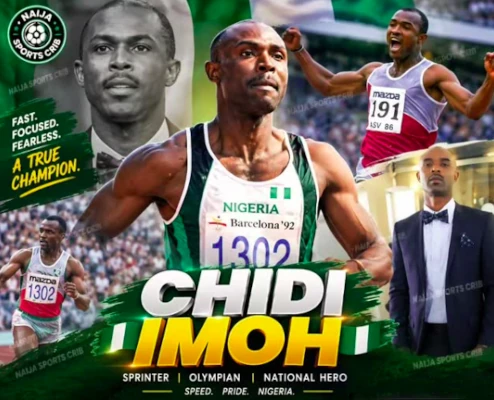
There was a time when the mention of Chidi Imoh’s name could bring an entire room of Nigerians to attention.
We were not talking about football.
We were talking about a young Nigerian who could line up alongside the fastest men on earth and make them worry.
Carl Lewis. Ben Johnson. Linford Christie.
These were not ordinary athletes. They were the men who dominated international sprinting during an era when the men’s 100 metres was one of the most eagerly anticipated events in world sport.
And somewhere among them was our own Chidi Imoh.
For those of us who followed athletics in the 1980s, his name still evokes memories of national pride. Here was a Nigerian who needed no introduction on the international circuit. He belonged there.
But as the years passed, the television appearances became fewer. New generations of sprinters emerged. New records were established. And, gradually, one of Nigeria’s most recognisable sporting names faded from everyday conversation.
Which brings us to the question behind our new series.
Whatever happened to Chidi Imoh?
Chukwudi Chidi Imoh was born on August 27, 1963. Raised in Aba, in present-day Abia State, he did not begin his sporting journey as the internationally celebrated sprinter he would eventually become.
Like many Nigerian boys of his generation, football was an early attraction. But his speed eventually took him in another direction.
The athletics track beckoned.
And what a remarkable decision that proved to be.
Imoh represented the old Imo State at national sporting competitions before securing an athletics scholarship to the University of Missouri in the United States. America offered him an opportunity to develop his natural talent through structured training and regular competition.
He seized it.
By 1983, the young Nigerian was already announcing himself on the international stage. At the World University Games in Edmonton, Canada, he won the men’s 100 metres.
Two years later, he repeated the achievement at the World University Games in Kobe, Japan.
Imoh was no longer simply a promising Nigerian athlete. He was becoming an international sprinting sensation.
To appreciate Chidi Imoh’s achievements, we must remember the period in which he competed.
Today, the world is familiar with athletes running 100 metres in less than ten seconds. But in the mid-1980s, the ten-second barrier remained a formidable benchmark.
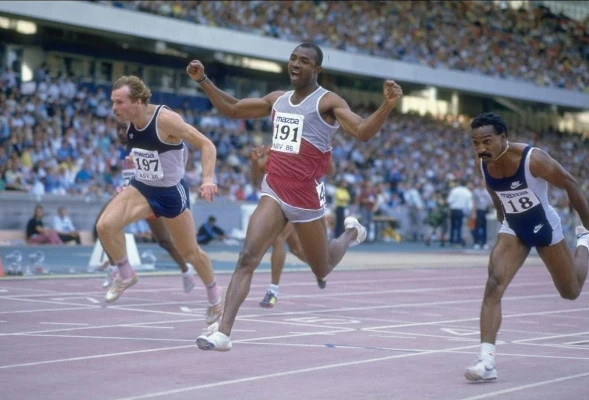
On August 15, 1986, at an athletics meeting in West Berlin, Chidi Imoh ran the 100 metres in exactly 10.00 seconds.
It was an African record and the fastest legal time recorded anywhere in the world that year.
Imagine that for a moment.
A young man from Aba was, on the evidence of the clock, the fastest man in the world that year.
And he was Nigerian.
If 1986 was remarkable, 1987 brought an even more extraordinary performance.
At the All-Africa Games in Nairobi, Kenya, Imoh lined up for the men’s 100 metres final. When he crossed the finishing line, the clock read 9.92 seconds. The standing world record was 9.93 seconds.
For a moment, it appeared that a Nigerian had broken the world record. Unfortunately, there was a problem.
The wind had been blowing at 4.4 metres per second, more than twice the permitted limit for record purposes. His time could not be recognised as a world record.
But he had won the African Games gold medal, and nobody could take that away from him.
Imagine the excitement of that afternoon. A Nigerian had run 100 metres faster than the official world record, even if the wind had helped him.
Chidi Imoh had truly arrived.
Perhaps one of the most revealing performances of Imoh’s career came at the 1986 Goodwill Games in Moscow. The field included Ben Johnson and Carl Lewis, two of the biggest names in international athletics. Imoh finished second behind Johnson, ahead of Lewis.
For Nigerian sports enthusiasts, that result meant something.
Our man was not simply making up the numbers at international competitions. He was competing for medals against the very best.
He had also won consecutive African 100-metre championships in 1984 and 1985. By the end of the decade, he had established himself as one of the defining figures of Nigerian sprinting.
There was, however, one particularly disappointing chapter. In 1986, when Imoh was enjoying arguably the finest form of his career, Nigeria joined the boycott of the Commonwealth Games in Edinburgh.
The decision was part of the wider African protest against Britain’s sporting links with apartheid South Africa.
It denied Imoh an opportunity to compete at the Games during the year in which he recorded the world’s fastest 100-metre time.
Sometimes, an athlete’s career is shaped by decisions made far away from the running track.
By 1992, Imoh had already competed at two Olympic Games.
He had enjoyed individual success across Africa and internationally, including a bronze medal in the 60 metres at the 1991 World Indoor Championships in Seville.
But an Olympic medal remained elusive.
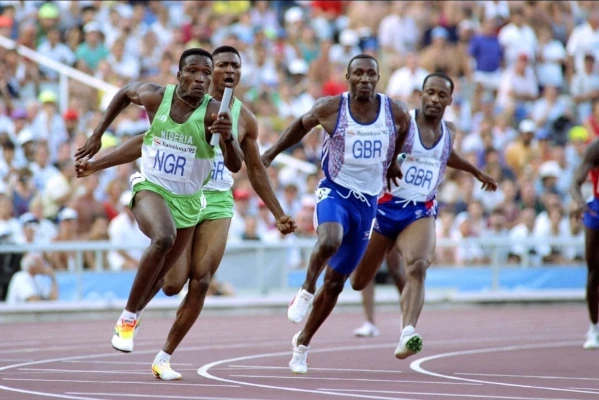
Then came Barcelona.
Nigeria assembled an outstanding men’s 4 × 100 metres relay team comprising Oluyemi Kayode, Chidi Imoh, Olapade Adeniken and Davidson Ezinwa.
The Americans were formidable.
Yet Nigeria produced an exceptional performance, finishing second in 37.98 seconds, behind a United States team that set a world record of 37.40 seconds.
What a moment that must have been.
Four Nigerians standing on the Olympic podium, having beaten nearly everyone the world could assemble.
It was a fitting achievement for a man who had spent so many years carrying Nigeria’s sprinting ambitions.
But as Barcelona became history, the end of Imoh’s competitive career was approaching.
Imoh’s later career was not without controversy.
Historical athletics records report that he received a four-year doping suspension in 1994. The readily available records do not establish all the circumstances of the case or provide his account of it, so those details should not be assumed.
It was an unfortunate chapter in the career of an athlete whose achievements had already secured him a place in Nigerian sporting history.
Eventually, Imoh disappeared from the international athletics circuit.
The man whose name had once appeared alongside Lewis and Johnson was no longer a regular presence on our television screens.
So where did he go?
Here is where Chidi Imoh’s story takes an interesting turn.
After athletics, he established a life in the United States.
Published biographical accounts report that he trained and worked as a nurse in California. A 2020 profile also reported that he was living in the United States with his family.
Think about that transition.
For years, Imoh had been accustomed to the noise of international stadiums, the tension of major championships and the excitement of competing against the world’s fastest athletes.
His life after sport took him into healthcare, a profession far removed from the glamour of international athletics.
There is something rather interesting about an athlete who spent his youth competing for fractions of a second eventually pursuing a career devoted to caring for other people.
But how much do we actually know about his life today?
Not nearly enough.
I found no sufficiently recent, independently verified account establishing whether he is still practising nursing, where he currently lives or what occupies his time in 2026.
And that, perhaps, is one of the reasons this series is necessary.
We remember the medals and the records. We remember the television appearances and the national celebrations.
But how often do we follow the lives of our sporting heroes once their competitive careers end?
There is another aspect of Imoh’s story that I find particularly interesting.
In a 2016 interview with TheCable, he spoke about his years representing Nigeria, the pride he felt wearing the national colours and his disappointment with the country’s treatment of athletes.
He said he had received no scholarship funding from Nigeria, explaining that the support he obtained was limited to feeding and travel allowances.
Yet he remained emphatic about his attachment to the country.
According to Imoh, he had opportunities to change his nationality but rejected them. He wanted to compete in Nigeria’s green-and-white colours.
It is worth remembering that this was a man who had spent years abroad, developed his career through an American university and competed successfully against the world’s leading athletes.
His international success did not diminish his attachment to Nigeria.
Indeed, in that same interview, he recalled Nigerians from different ethnic backgrounds approaching him during his travels to express their pride in his achievements.
For those moments, at least, athletics had done what we so often wish other aspects of our national life could do.
It had united us.
There was no question of where Chidi Imoh came from.
He was simply our Chidi Imoh.
And he was making us proud.
In 2020, the University of Missouri inducted Chidi Imoh into its track and field Hall of Fame, recognising the remarkable contribution he had made during his collegiate career.
It was a reminder that the achievements of our sporting heroes are often remembered far beyond Nigeria’s borders.
Imoh turned 63 in August 2026.
For those who watched him in his prime, he remains a reminder of a particularly exciting period in Nigerian athletics.
The era of Innocent Egbunike, Sunday Uti, Yusuf Ali, Ajayi Agbebaku and a generation of athletes who demonstrated that Nigerians could compete successfully against the world’s best.
Imoh was very much a part of that generation.
And his story raises a question that goes beyond athletics.
How well do we preserve the memories of the men and women who brought honour to our country?
Do we know what became of them?
Do we celebrate their achievements sufficiently?
And, perhaps more importantly, do younger Nigerians even know who they are?
We have become accustomed to celebrating sporting victories as they happen, then moving on to the next competition, the next athlete and the next medal.
But national sporting history deserves more than occasional nostalgia.
It deserves to be preserved, documented and passed on.
Our search has taken us from the tracks of Aba to the University of Missouri, from the great international sprinting contests of the 1980s to that unforgettable Olympic silver medal in Barcelona.
And then to the United States, where published accounts tell us that Imoh built a life outside athletics and entered the nursing profession.
There are still questions we would like to ask him.
Does he still follow Nigerian athletics?
What does he think when he watches today’s generation of sprinters?
Does he ever reflect on that extraordinary afternoon in Nairobi when he ran 9.92 seconds?
And what advice would he give a young Nigerian athlete who dreams of becoming the fastest man in the world?
Perhaps one day, we will have the opportunity to sit down with him and ask those questions ourselves.
Until then, one thing remains certain.
For a glorious period in the 1980s, a young man from Aba could step onto a running track anywhere in the world, look the fastest men on earth in the eye and believe he could beat them.
His name was Chidi Imoh.
And we should never forget him.
Editor’s note: The account of Imoh’s post-athletics life is based on published reports, not a recent personal interview. His present residence and employment have not been independently confirmed.
From My Window | A view. An opinion. Our Reality.



Leave a Reply