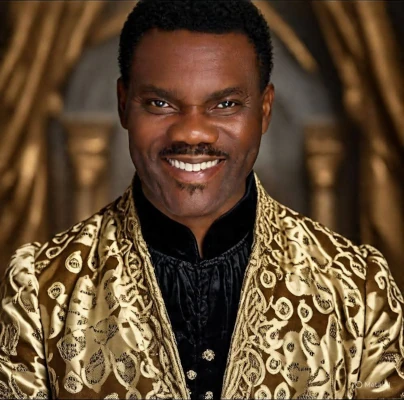
By Chris Osa Nehikhare | Publisher, From My Window
Some people paint what they see.
Others paint what they remember.
And then there are artists who paint so that a people do not forget.
Enotie Ogbebor belongs in that last category.
Painter. Sculptor. Multidisciplinary artist. Cultural activist. Mentor.
But perhaps, above everything else, a custodian of memory.
His canvases are filled with colour, but behind the colour are stories — of Benin, of Africa, of colonial encounters, migration, environmental degradation, identity and the continuing struggle to determine who owns history and who gets to tell it.
For Enotie, art is not merely something beautiful to hang on a wall.
It is a voice.
Born in Benin City in 1968, Enotie’s relationship with art began long before he contemplated making a profession of it.
His maternal roots connected him to the famous Igun bronze-casting community.
As a child, he watched family members work as bronze casters. He moulded clay and sketched constantly. During school holidays, he was exposed to traditional craftsmanship and apprenticed for a period under the late master carver Imagbenekaro.
His parents noticed the interest early enough to provide private art tuition.
But when university came, Enotie did not study Fine Art.
He studied Economics and Statistics at the University of Benin.
Perhaps that apparent contradiction tells us something about the man.
The degree provided one education.
Benin provided another.
And art never left him.
He eventually emerged as a self-taught multidisciplinary artist whose work would travel far beyond the city where the journey began.
Enotie’s artistic language is difficult to confine to one medium.
Painting. Sculpture. Installation. Multimedia. Music.
His work frequently returns to questions about history, culture and society.
Human trafficking and migration.
Environmental destruction.
Colonialism.
Identity.
And, repeatedly, Benin.
His paintings can be vibrant and beautiful, but the beauty often carries an uncomfortable question beneath it.
What have we lost? What are we losing? And what should we preserve?
That tension between beauty and memory has become an important part of his work.
To understand Enotie Ogbebor properly, one must understand his relationship with Benin heritage.
The 1897 British invasion of Benin did not merely remove an Oba from his throne.
It dispersed thousands of objects through museums and private collections across the world.
More than a century later, the debate over those objects — commonly called the Benin Bronzes — has become one of the world’s most significant conversations about restitution and the legacy of colonialism.
Enotie has been one of the Edo voices in that conversation.
He worked with the Benin Dialogue Group, engaging museums and cultural institutions around the return of looted Benin artefacts.
But there is something particularly appropriate about an artist participating in that struggle.
Because the objects being discussed are not simply historical evidence.
They are art and of course memory.
They are records of a civilisation speaking through bronze, ivory and wood.
For Enotie, therefore, restitution is not an abstract international debate.
It is a conversation about home.
There is an interesting symmetry in Enotie’s journey.
The young boy who grew up watching bronze casters in Benin would eventually enter some of the world’s great museums not merely as a visitor, but as an artist and contributor to conversations about the very culture from which he came.
His relationship with the University of Cambridge’s Museum of Archaeology and Anthropology included work connected to the Benin Dialogue Group and later an artist residency.
There, he developed From Eden to Ecocide: A Tale of Human Impact, examining humanity’s changing relationship with nature and the environmental consequences of development.
His work has also been exhibited at the British Museum, while pieces by him have entered important international collections.
There is something worth reflecting upon in that journey.
A contemporary Edo artist is now creating work that sits within institutions that also hold objects produced by Edo artists centuries before him.
Past and present are meeting in the same rooms.
But perhaps one of the most important parts of the Enotie Ogbebor story is happening away from the international exhibitions.
Back home.
Through Nosona Studios in Benin City and the Edo Global Art Foundation, Enotie has created spaces where younger artists can learn, work and find expression.
More than 800 artists are reported to have passed through this ecosystem of training and mentorship.
That number deserves attention.
Because there comes a stage in accomplishment when the question should no longer be:
What have you achieved?
The better question becomes:
Who have you helped to become?
Enotie has understood that.
Rather than allowing young Edo artists to believe that recognition can only be found by leaving Benin for Lagos, London or elsewhere, he has helped create a space where talent can be nurtured at home.
That may ultimately become one of his most enduring works.
Not a painting.
Not a sculpture.
But people.
Benin has always understood the power of art.
Long before modern galleries and museums, our artists were recording history.
They cast kings in bronze.
They carved stories into ivory.
They preserved victories, ceremonies, dress, hierarchy and identity.
Centuries later, those works allow the world to encounter a civilisation whose sophistication survived even attempts to destroy it.
Enotie Ogbebor belongs to that continuum.
His tools may be contemporary.
His subjects may include climate change, migration and modern social anxieties.
But the underlying instinct is familiar.
Tell the story.
Preserve the memory.
Leave something behind.
That is why his work matters beyond aesthetics.
Benin has given the world an extraordinary artistic inheritance. Our ancestors told their stories in bronze, ivory, wood and clay, creating masterpieces that continue to command international attention centuries later.
But heritage cannot survive on yesterday’s achievements alone. Every generation must find its own voice and make its own contribution.
Enotie Ogbebor understands this responsibility.
Through his art, his advocacy for the restitution of Benin’s cultural treasures and his commitment to nurturing younger artists, he has become part of the continuing story of Benin’s artistic civilisation.
He is not content merely to celebrate what our ancestors created. He is helping to ensure that the next generation has the opportunity to create its own masterpieces.
From my window, that is what makes Enotie’s journey particularly significant. He has taken the artistic inheritance of Benin, interpreted it through a contemporary lens and carried its message beyond our shores, while remaining firmly connected to home.
The bronze tells the story of where we have been.
The brush tells the story of who we are.
And through artists like Enotie Ogbebor, the Benin story continues to be written.
Enotie Ogbebor is an Edo Icon.
From My Window | A view. An opinion. Our Reality.

Leave a Reply